

The Problem Every Company Has
Behind every company — from a 50-person startup to a Fortune 500 — sits a tangle of systems accumulated over years:What FIM One Does
FIM One is the external, third-party, horizontal platform that connects all of them. Think of Eywa from Avatar — the neural network beneath Pandora that connects every tree, every creature, every memory into one living system. Each organism stays independent, but through Eywa they sense each other, share information, and act together when needed. No organism is modified; Eywa simply makes the connection possible. FIM One is your enterprise’s Eywa. Your ERP, CRM, OA, and databases remain exactly as they are — FIM One weaves the intelligent network between them, so they can finally talk to each other through AI.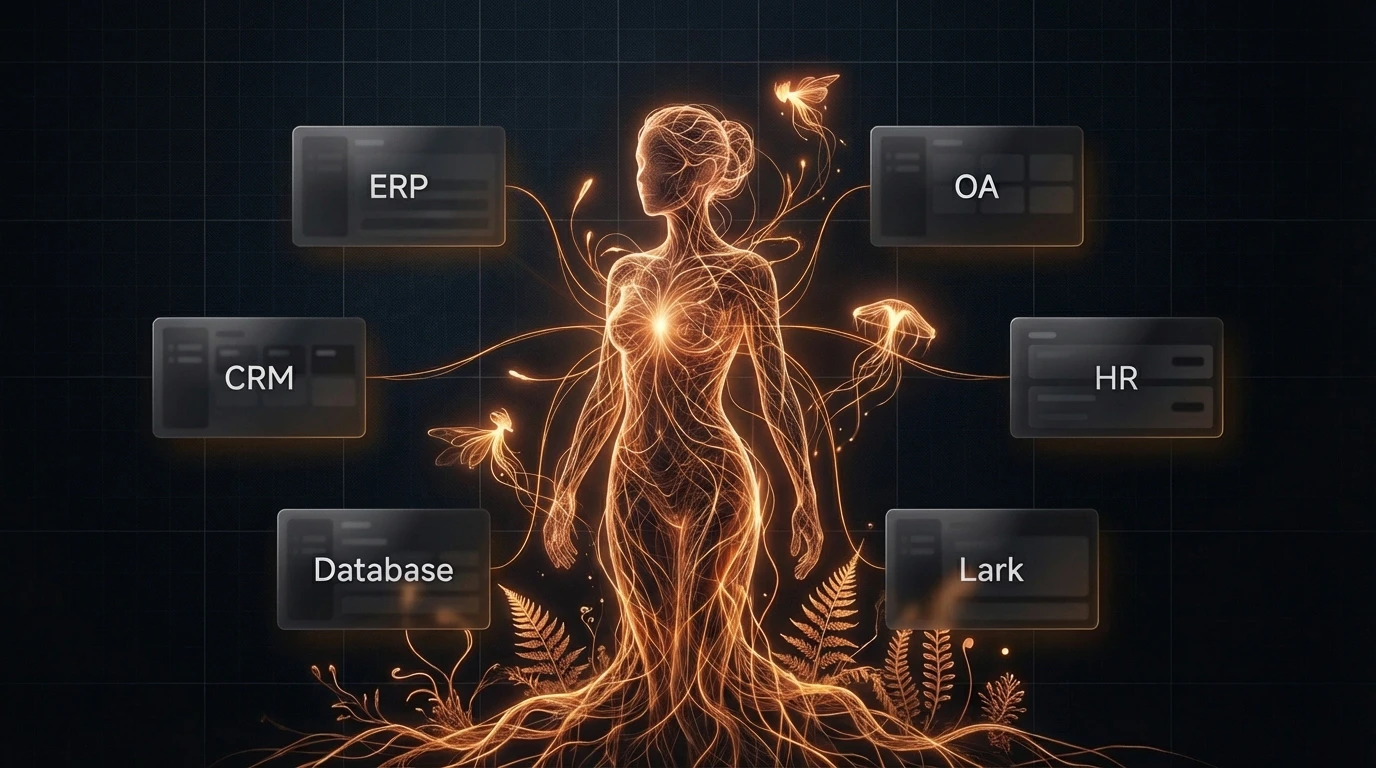
- Database credentials (read-only accounts recommended)
- API endpoints and authentication keys
- Network whitelist access
- AI that understands and orchestrates across all your systems
- Every operation audited, every write gated by human confirmation
- Your data stays in your systems — FIM One provides the intelligence layer, not a data lake
Two Modes, One Platform
Land and Expand: Start with a Copilot in one system. Users see immediate value without learning a new tool. When the ROI is proven, scale it to the cross-system agent platform — a central portal where every system you already run meets AI through one agent core. The Copilot keeps running; the platform adds cross-system intelligence.
Copilot proves value inside one system. The agent platform unlocks value across all systems.
Why Not Just…
…use MuleSoft or traditional iPaaS?
MuleSoft connects systems to systems. FIM One connects systems to AI. Traditional iPaaS requires months of custom mapping, dedicated integration teams, and six-figure contracts. FIM One understands your data semantically — describe what you want in natural language, and the AI figures out which systems to query and how to combine the results.…write ETL pipelines yourself?
ETL breaks every time a source system upgrades its schema. FIM One connects live — no data copying, no sync jobs, no pipeline maintenance. And it works bidirectionally: read from one system, write to another, with human confirmation on every write.…use Dify, n8n, or a workflow builder?
Workflow builders ask you to replicate your business logic on a new canvas. But your workflows already exist — in your OA, your ERP, your approval systems. You don’t want another flowchart editor. You want AI that connects to the systems where those flows already run. FIM One doesn’t duplicate workflow logic. From the connector’s perspective, every complex operation — transfer, reject, escalate, co-sign — collapses to a single API call with parameters. The target system manages the state machine. FIM One just calls the API.…use an AI agent platform (Manus, AutoGPT)?
Autonomous agents are powerful but uncontrolled. They burn tokens retrying failed APIs, drift from goals, and can’t connect to your proprietary systems without custom integration. FIM One provides bounded autonomy — dynamic planning with guardrails, circuit breakers on failing connectors, and human confirmation gates on write operations.…let each vendor’s built-in AI handle it?
Feishu AI works inside Feishu. Salesforce Einstein works inside Salesforce. Neither can cross the boundary. No vendor will build genuine cross-system integration — it’s against their lock-in incentive. FIM One is the only player without that conflict of interest.How FIM One Connects
FIM One uses a three-layer architecture that separates transport from governance:
The agent doesn’t know or care whether it’s talking to SAP, a PostgreSQL database, or a custom REST API. Connectors are standardized bridges — adding a new system requires only connector configuration, not code changes.
Three Ways to Build Connectors
You don’t need to write Python to connect a new system:
For enterprise databases, FIM One supports direct SQL access to PostgreSQL, MySQL, Oracle, SQL Server, and the enterprise databases deployed widely in China (DM, KingbaseES, GBase, Highgo) — the ones most global AI platforms can’t reach — with schema introspection, AI-powered annotation, and read-only query execution.
Why Now
Two things changed that make FIM One possible today: 1. AI models are finally smart enough to orchestrate. GPT-4, Claude, and Gemini have native tool calling, long context windows (200K+), and reasoning capabilities that make dynamic cross-system orchestration reliable. Three years ago, this was a research problem. Today, it’s an engineering problem. 2. The connection layer is still nobody’s job. Models keep getting smarter, but they will never natively encrypt your database credentials, manage your OAuth tokens, enforce your RBAC policies, or audit your tool calls. That’s infrastructure work — and it’s the work FIM One does.The further from pure LLM orchestration toward enterprise system integration, the more durable the moat.AI models own the intelligence. FIM One owns the connection. Smarter models make FIM One better, not redundant — because better reasoning means better cross-system orchestration through the same connectors.
Get Started
Quick Start
Get FIM One running in minutes with Docker or local development.
Connector Architecture
How FIM One connects to your systems — the three-layer architecture.
Execution Modes
Standalone, Copilot, and Hub — three ways to deploy.
Try on Cloud
No setup required — sign in and start connecting.